OSSIE Colhoun celebrates his 82nd birthday today and although it is half his lifetime since his 87th and final game for Ireland, one match remains ingrained in the memory bank – and it all happened less than half a mile from his home.
Colhoun was the primary reason why West Indies ended up playing at Sion Mills on July 2, 1969, the day after they had drawn the second Test match against England at Lord’s. There could hardly have been a bigger contrast. From the Home of Cricket to a factory ground in the north west of Northern Ireland.
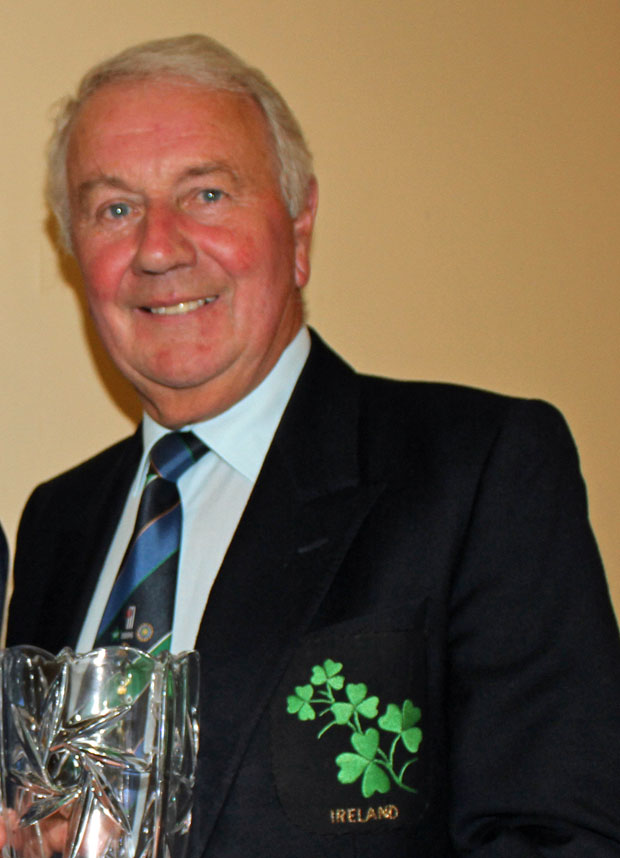
(Ossie Colhoun)
The North West had hosted only two of Ireland’s previous 252 matches – 29 years apart. Sion actually staged the first, against MCC in 1934 and Beechgrove, which would be the regular go-to international ground in the area, was the venue for the first-class game against Scotland.
The visit of a touring team was, though, always the highlight of the Ireland season. “This was the big one,” Colhoun, as busy and sprightly as ever, recalls.
“Everyone wanted to see the West Indies. Even the TV cameras were there that day, Neil Durden-Smith and Malcolm Kellard the commentators. The ground was packed.”
Back then, Ireland were a totally amateur side, with players usually meeting up on the morning of the game, squeezing in a day of international cricket between their day jobs, but to save the majority of the team a long journey, this time the players met up the night before.
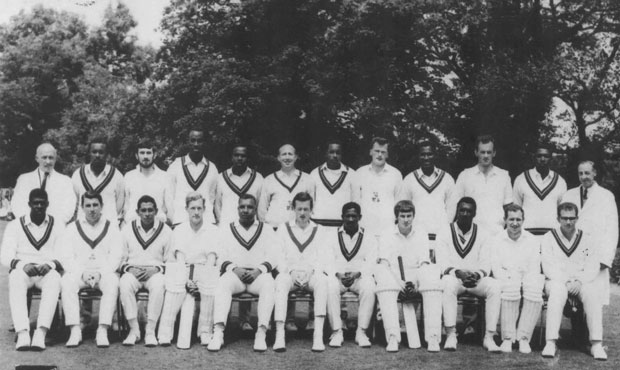
(Ireland and West Indies teams)
In 1969, Ireland would play seven matches – only once before in a calendar year had they ever played more – and the visit of West Indies for a one-day game at Sion and a two-day game in Belfast were their second and third of the year.
Ireland were forced to make one change from the team that had lost the annual three-day game against Scotland three weeks earlier in Dublin, with Waringstown batsman Michael Reith given his debut in place of the injured Dermott Monteith.
“I had organised to meet Ivan Anderson and Reith in the local pub but, as the local man, I ended up escorting the West Indies party to their hotel in Lifford,” says Colhoun, who also confirms that the story of the tourists spending the night drinking Guinness is apocryphal.
“They had just flown in from London, it was a late hour, they got no drink at all and went straight to their beds.”
Colhoun was the most experienced player in the Ireland line-up. The game at his home ground was his 39th international and of his team-mates only Alex O’Riordan and Gerry Duffy had won more than 14 caps.
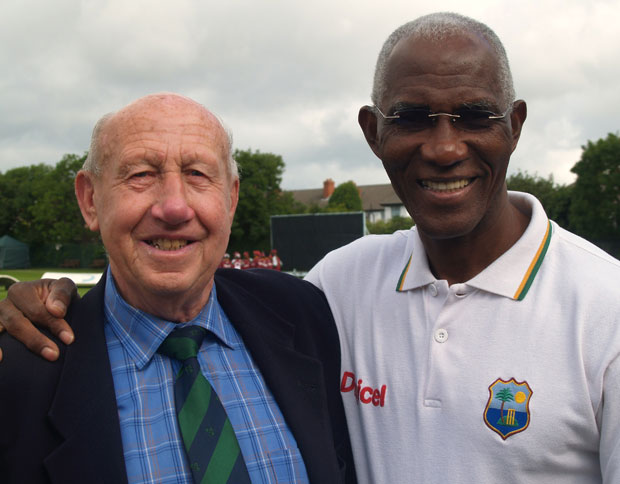
(Gerry Duffy and Michael Findlay pictured at Castle Avenue in 2007)
“I’d been in the Irish team for 10 years and the first year we played three counties, Lancashire, Yorkshire and Leicestershire, so it was a tough start.
“We didn’t play many matches but we usually got the teams that were touring England over to Ireland and so I had already played against Australia twice, Pakistan, West Indies, in 1963, New Zealand and India, but this was the first time a touring side had been in the North West and I think, without being big-headed, it was because I had been in the Irish team for so long and they probably owed us a match.”
Ossie’s cousin, Aubrey Finlay played 18 games for Ireland and the village also produced two international footballers, Allan and Victor Hunter. But it was cricket and Herdman’s Flax Mill, which overlooked the ground, which dominated village life.
Long before Belfast and Dublin teams started to employ professionals, Sion had one and Ossie was one of the beneficiaries.
“He came as a teacher and you called him ‘Sir’. When I started in Herdman’s as a lad, he went to my boss’s boss and asked if I could get out to be coached in the afternoon. So he must have seen something in me because I got out of work twice a week for an hour. But Herdman’s were very good to cricket, it was the third religion. When you went back to work on the Monday, if you had dropped a catch on the Saturday, you got slagged!”
There was no work done in Herdman’s that first Wednesday in July 1969 as the employees lined the ground and awaited the arrival of the West Indies team. Six of the side that had played at Lord’s turned out again at Sion, although to the disappointment of the estimated 2,000 spectators, the great Garfield Sobers was not one of them. The primitive changing room conditions would have been the first shock to the tourists, as Ossie recalls.
“It was only a small pavilion, with one toilet and no showers. We had a full time groundsman though, so the ground had never looked better and the pitch had been passed by a fellow from Yorkshire.
“On one side of the ground was a railway line and the other side had a river and when the ball went in the young boys had to get a pole to drag the ball out.”
If West Indies captain Basil Butcher had a choice, he would undoubtedly after asked Ireland to bat first on the damp, grassy pitch but everyone had come to watch the calypso kings bat so, just before 11.30am, their opening batsmen Steve Camacho – fresh from scores of 67 and 45 at Lords - and Joey Carew walked to the middle.
“Unfortunately for the West Indians they had been batting on a hard wicket at Lord’s and here they were having to play on a slow pitch, the ball taking a piece out of the wicket every time it was bowled and so their timing was way off,” says Colhoun.
With O’Riordan and captain Dougie Goodwin bowling an immaculate line and length, barely an hour later, nine West Indies batsmen were back in the small pavilion with just 12 runs scored. There were four ducks and only tour manager Clyde Walcott scored more than two. A couple of lusty blows by No 10 batsman Grayson Shillingford saw 12 come off the next over but after just 86 minutes Ireland had bowled out the mighty West indies for 25.
Goodwin had bowled 12 overs and taken five wickets for six runs and O’Riordan, because of that one expensive over, finished with four for 18. There was still 25 minutes left before lunch and Ireland scored 19 runs for the loss of one wicket leaving them just seven more to complete a famous victory. Five overs later, the victory margin was nine wickets but the teams had agreed at lunchtime to give the spectators a full day’s cricket which saw Ireland declare on 125-8 – exactly 100 ahead - with opening batsman David Pigot top scoring with 37.
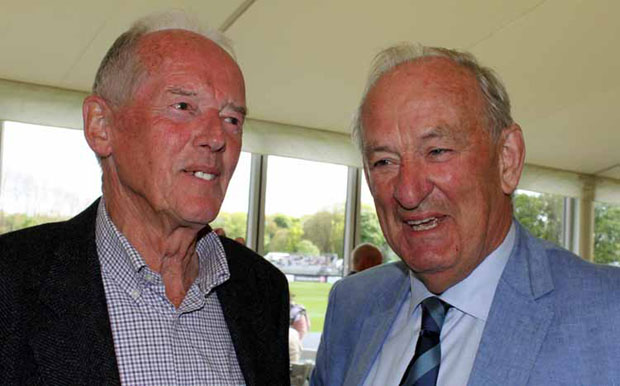
(Dougie Goodwin and Alec O'Riordan at Malahide Test Match in 2018)
That left West Indies with 95 minutes batting and, in another stunning start to their innings, Goodwin took two wickets in his first over. But, finally, the tourists managed to put a partnership together with Carew and Butcher adding 72 for the third wicket. Gerry Duffy, the oldest member of the team at 38 years old, removed both batsmen as they closed on 78-4.
In all, Ireland took 12 catches in the day – a feature of their performance, as Colhoun recalls. “There were a couple of good ones and we didn’t miss any,” he said. It was just one of the days which will probably never be repeated. Good memories. I still go down to the field and have a look around.”
There was no chance of any celebrations because the teams headed straight to Belfast for their two-day game. “I took Reith back to our house and made him his tea!” adds Ossie.
It was a much improved West Indies display at the old Ormeau ground but Ireland, after surrendering a first innings lead of 162, batted more than four hours in their second innings for a draw with nine wickets down to “win the series”.
As for Colhoun, the outstanding wicket-keeper of his day, he would play for another 10 years and did not miss one of Ireland’s next 47 matches. But none of them was played at Sion Mills which never hosted another international.
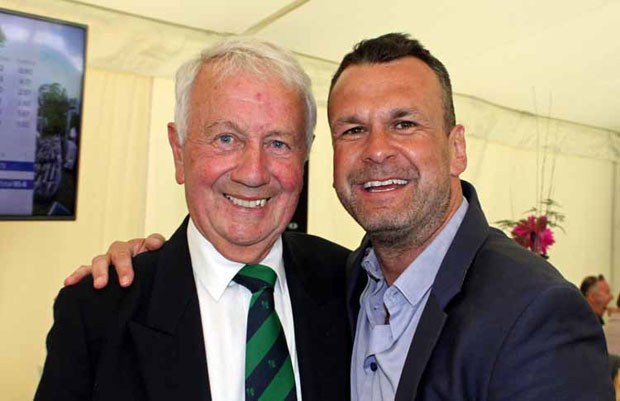
(Irish keepers from the NW, Ossie Colhoun and Stephen Ogilby)
“I enjoyed every minute of it, maybe I went on a bit too long, I played my last game when I was 41, but wouldn’t have missed it for the world.”
When Ossie retired, he was Ireland's most-capped player, a record he would hold for another nine years until surpassed by Michael Halliday.
Happy birthday, Ossie.